
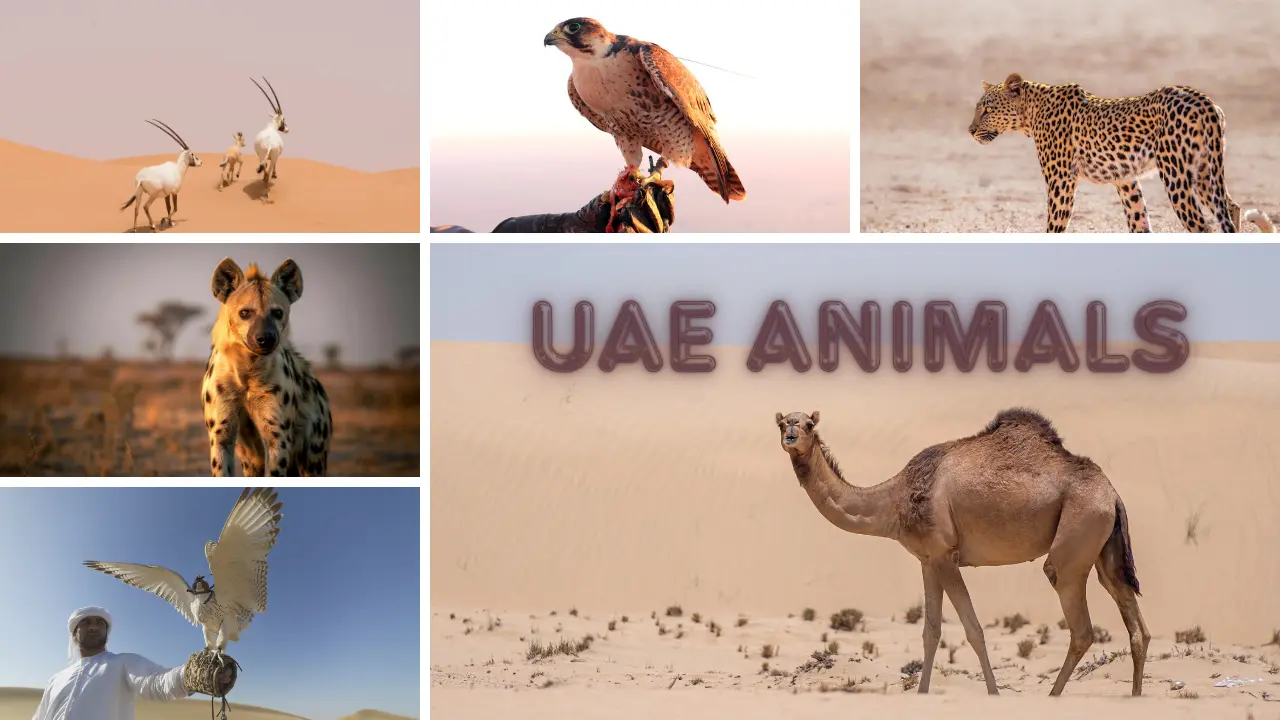

The Camel Myth — and the Real National Animal
Ask most people what animal represents the UAE, and “camel” comes up almost instantly. It’s understandable — dromedaries dominate tourism imagery — but the camel has never held that official title, and it isn’t even native to the region in the way most assume. Camels were introduced as domesticated animals roughly 2,000 years ago.
- The Camel Myth — and the Real National Animal
- Native Desert Mammals — Built to Survive the Unsurvivable
- The Oryx Comeback — A Conservation Timeline Worth Knowing
- Predators and Rare Species — What’s Left, and What’s Being Done
- Birdlife — Falconry, Flamingos, and Migration Season
- Marine Wildlife — The UAE’s Underrated Ecosystem
- Reptiles — Should You Be Worried?
- Threats and Conservation — The Honest Picture
- Where to See UAE Wildlife — Free vs. Paid Options
- FAQs
The actual national animal is the Arabian Oryx (Al Maha), officially designated in 2008. It’s a near-white antelope with dark facial markings and long curved horns. The choice carries weight because the oryx was hunted to extinction in the wild by the early 1970s, then brought back through one of the region’s most successful conservation programs.
The Saker Falcon holds a different title — national bird, and the centerpiece of the UAE’s coat of arms. Falconry isn’t just symbolic either; it’s a living tradition, with facilities like the Abu Dhabi Falcon Hospital treating birds as routine practice.
Quick Reference: National Symbols
| Symbol | Animal | Status |
|---|---|---|
| National animal | Arabian Oryx (Al Maha) | Designated 2008; IUCN Vulnerable |
| National bird | Saker Falcon | Central to UAE coat of arms |
| Cultural icon (not official) | Dromedary camel | Introduced ~2,000 years ago |
Native Desert Mammals — Built to Survive the Unsurvivable
The UAE’s interior is brutal: lethal ground temperatures in summer and scattered, unreliable water. The animals that persist here have evolved specific physiological workarounds rather than just “toughing it out.”
- Arabian sand gazelle — gets most of its water from moisture-retaining plants, rarely needs to drink directly. Pale coat reflects heat.
- Arabian red fox — largely nocturnal, retreating to cooler burrows by day to avoid peak heat.
- Caracal — the “desert lynx,” solitary except when mating, survives long dry spells by drawing moisture from prey.
- Arabian tahr — found only in the Al Hajar Mountains’ cooler north-facing slopes; population estimated at ~5,000, classified Endangered.
- Ethiopian hedgehog — one of the few small mammals thriving at the edges of settlements, foraging at night.
The Oryx Comeback — A Conservation Timeline Worth Knowing
The Arabian Oryx’s national symbol status makes more sense once you see the actual sequence of events.
| Period | Milestone |
|---|---|
| Late 1960s | Unregulated, vehicle-assisted hunting pushes wild oryx near extinction |
| 1970s | Sheikh Zayed bin Sultan Al Nahyan launches captive breeding at Al Ain Zoo |
| Following decades | Reintroduction expands to protected reserves, including Sir Bani Yas Island |
| 2011 | IUCN reclassifies the species from Extinct in the Wild to Vulnerable |
| Today | UAE holds one of the largest wild Arabian Oryx populations globally |
What makes this notable isn’t just the outcome — it’s that the entire arc happened within living memory, through a traceable chain of decisions that now serves as a template for other species recovery efforts in the region.
Predators and Rare Species — What’s Left, and What’s Being Done
Not every story has reached a happy ending yet.
Arabian leopard (Panthera pardus nimr) — Critically Endangered. Sightings in the UAE are exceptionally rare, with most evidence coming from camera traps rather than direct observation. Reintroduction is harder than it was for the oryx, since leopards need large territories and a reliable prey base.
Striped hyena — Often dismissed as “just a scavenger,” but fills a genuine ecological role by clearing carrion in areas other predators avoid. Highly territorial, patrolling nightly.
Arabian wolf — Hunts in small groups of two to four, taking hares and rodents but also scavenging near settlements. This habit creates conflict with farmers when wolves prey on livestock, which has historically driven population declines — now offset partly by captive breeding programs.
Birdlife — Falconry, Flamingos, and Migration Season
Roughly 400 bird species have been recorded in the UAE, many migratory — which is why “best season to see X” questions matter so much here.
- Saker Falcon — national bird, with falconry remaining an active practice rather than a historical relic.
- Houbara bustard — ground-dwelling, under pressure from habitat loss and past hunting; now a focus of breeding programs.
- Flamingos and migratory flocks — best seen in winter at Ras Al Khor Wildlife Sanctuary, a free wetland reserve at the mouth of Dubai Creek with three public observation hides.
- Al Wathba Wetland Reserve (Abu Dhabi) — over 200 migratory bird species, plus 230+ invertebrate species, 11 mammals, and 10 reptiles in one protected area.
Marine Wildlife — The UAE’s Underrated Ecosystem
Land animals dominate the conversation, but some of the country’s most globally significant wildlife is underwater.
Abu Dhabi’s waters host one of the largest dugong populations in the world — often cited as second only to Australia’s — centered on the Marawah Marine Biosphere Reserve, which UNESCO designated in 2007 as the Arab region’s first marine biosphere reserve. The designation protects seagrass beds, coral communities, sea turtles, and dugongs as one connected system.
Beyond dugongs, expect humpback dolphins, sea turtles, whale sharks, and stingrays offshore, plus mangrove habitats like Jubail Mangrove Park supporting herons and crabs closer to the coast.
Reptiles — Should You Be Worried?
A common unspoken question behind “UAE animals” searches: is anything out there dangerous? Mostly, no.
The UAE has around 56 known terrestrial reptile species. The Dhub (Egyptian spiny-tailed lizard) is the most recognizable — large, herbivorous, heat-adapted, and historically part of local diets in some communities. Smaller species like the spotted toad-headed agama and fan-footed rock gecko are common but harmless, using tail movements and territory rather than aggression.
Venomous snakes exist, as across most of the Arabian Peninsula, but sightings near populated areas are uncommon and serious incidents are rare.
Threats and Conservation — The Honest Picture
| Threat | Impact |
|---|---|
| Illegal wildlife trade | UAE’s role as a global transport hub creates persistent risk (ivory, exotic birds, reptiles) despite strong enforcement |
| Feral cats | Prey on ground-nesting birds and reptiles with no natural defenses against this introduced predator |
| Habitat fragmentation | Roads and development shrink space for gazelles and other species outside fenced reserves |
| Biosecurity at breeding sites | Concentrated animal populations raise disease transmission risk, requiring ongoing veterinary oversight |
Oversight sits primarily with the Environment Agency – Abu Dhabi (EAD) and the UAE Ministry of Climate Change and Environment, with the IUCN Red List serving as the reference point for tracking species recovery or decline.
Where to See UAE Wildlife — Free vs. Paid Options
| Option | Cost | Best For |
|---|---|---|
| Ras Al Khor Wildlife Sanctuary (Dubai) | Free | Flamingos and migratory birds, winter especially |
| Al Wathba Wetland Reserve (Abu Dhabi) | Free | Birdwatching, walking trails, guided events |
| Dubai Desert Conservation Reserve | Permit via licensed operator | Wild oryx, gazelles, possible wildcat sightings |
| Sir Bani Yas Island | Lodge stay + ferry | Native marine life plus introduced oryx, gazelles, cheetahs, giraffes |
| Dubai Safari Park | Paid entry | Guaranteed sightings of oryx, gazelles, wolves, camels in an Arabian Desert zone |
| Emirates Park Zoo (near Abu Dhabi) | Paid entry | Tahr and gazelle enclosures designed to mirror native habitat |
The practical takeaway: for genuinely native wildlife with no sighting guarantees, choose the conservation reserves or Sir Bani Yas. For reliable, low-effort sightings — including some non-native species — the zoo and safari park route is faster.
FAQs
Is the camel the national animal of the UAE?
No. The Arabian Oryx (Al Maha) has held that title since 2008.
Why was the Arabian Oryx chosen as the national animal?
It represents a major conservation success — from Extinct in the Wild to a stable, reintroduced population, largely through breeding programs that began at Al Ain Zoo in the 1970s.
Are there dangerous animals in the UAE?
Venomous snakes and scorpions exist, but encounters near populated areas are uncommon and serious incidents are rare.
Do lions, tigers, or bears live in the UAE?
Not natively. They’re found only in zoos and safari parks alongside native species.
Best time to see flamingos in Dubai?
Winter, at Ras Al Khor Wildlife Sanctuary.
How do you visit Sir Bani Yas Island?
By complimentary ferry from Jebel Dannah Jetty, usually as part of a lodge stay — typically planned as an overnight trip from Abu Dhabi.
What’s native vs. introduced?
Native: Arabian oryx, tahr, leopard, striped hyena, Arabian wolf, red fox, caracal, sand gazelle, dugongs, sea turtles, and ~400 bird species. Introduced: camels (~2,000 years ago), and zoo/park species like lions, giraffes, and zebras.