

Introduction
There is no lack of clinics in Dubai which offer treatment involving implants, and the advertising at all of them tends to be very similar. Whether or not you have a good or a frustrating experience is seldom apparent from the brochures; it mostly depends on the care with which your case was examined and on how clearly the plan was explained before any work started.
- Introduction
- Am I actually suitable for treatment on the same day?
- What imaging will be taken?
- Who will perform the surgery?
- What exactly will I leave with on the day?
- What happens if the implant is not stable enough?
- Which implant system will be used?
- How long until the final tooth is fitted?
- What does the aftercare plan involve?
- What is included in the written treatment plan?
- How is the implant maintained in the long run?
- How does this work around travel and time off?
- Practical points for residents and visitors
- Conclusion
- Contact Us
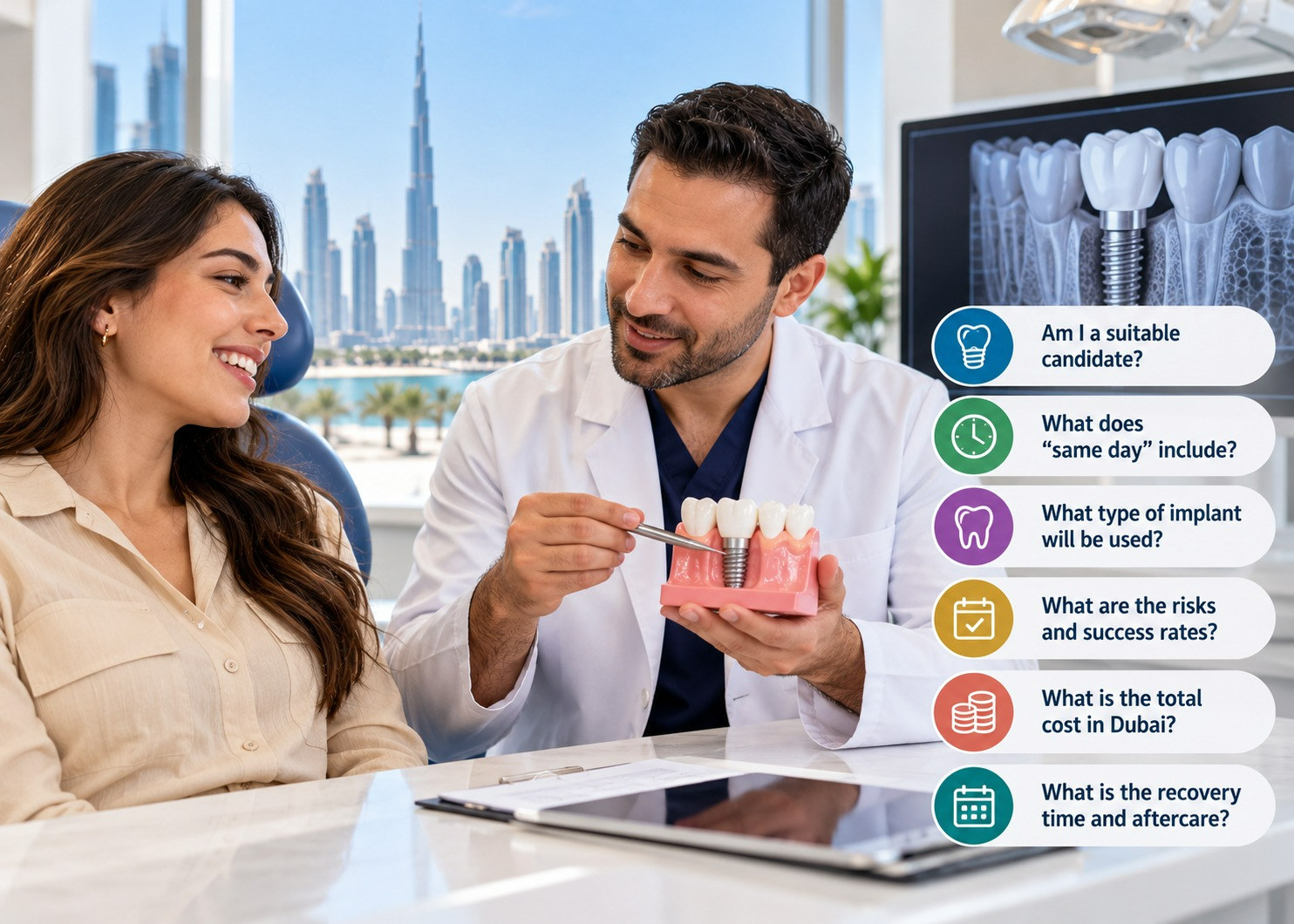
The right time to find out is during a consultation. The questions that are worth asking are listed below, together with an example of a helpful answer, so that when you go for the appointment you will be ready rather than just agreeing to terms you’ve never come across.
Am I actually suitable for treatment on the same day?
This is the first and at the same time the most important question; same-day dental implants require there to be sufficient healthy bone to securely hold the implant right from the beginning, together with healthy gums and stable overall health.
To answer this before examining you and looking at the scan is to answer too early. You should first have a proper assessment and, if a staged approach would be better for you, you should receive an honest explanation.
What imaging will be taken?
Three-dimensional imaging of the jaw is the standard procedure before starting implant treatment since flat X-rays are unable to display bone width or the precise position of the nerves and sinus.
Find out if a CBCT scan is provided, whether the scan is carried out at the clinic, and if the dentist will show it to you on the screen. The fact that you can see your own bone explained in visual terms tells you a lot about the thoroughness of the planning.
Who will perform the surgery?
Find out both the name and the qualifications of the dentist who is placing the implant and make sure that they are licensed by the Dubai Health Authority; since every dentist who is practising in the emirate must have a DHA licence, the information can be easily verified.
It would also be reasonable to inquire as to their experience with cases involving implants similar to yours, and to find out if the same clinician carries out both the surgery and the placement of the final crown or whether two clinicians share the work.
What exactly will I leave with on the day?
Clarity in this situation avoids disappointment; in most cases you end up with a temporary tooth rather than the permanent one, and this temporary tooth is intentionally made so that it exerts less pressure in the bite so as not to place a heavy load on the healing implant.
Find out what the temporary is made of, how natural it will appear, and what limitations it has. A person who claims to be able to achieve a completed result in one visit is in fact describing something that is different from the way implant healing really works.
What happens if the implant is not stable enough?
Even when careful planning has been carried out, the bone sometimes provides less hold than the scan indicated. In such a case, the better course of action is to allow the implant to heal with the bone in place before fitting a tooth.
A reputable clinic will mention this possibility from the beginning and inform you of the alternative arrangement, so that you aren’t surprised if you need to change your plans on the day.
Which implant system will be used?
Implants are produced by a number of manufacturers, and well-established systems are readily available for future servicing.
It is important to know the brand and model even years later; if you move to a different city or change dentists, the implant system you have can be matched with the appropriate parts. You should ask for those details in writing, and also request an implant passport or card if the clinic issues one.
How long until the final tooth is fitted?
Instead, expect a range of dates rather than a specific one; bone healing usually takes several months and this duration is affected by the quality of the bone, whether or not a graft was carried out, smoking, and conditions such as diabetes.
Find out how many of the review appointments occur during that time and what takes place at each one. Although immediate dental implants reduce the waiting period for being able to see the teeth, they do not shorten the biological healing that takes place underneath.
What does the aftercare plan involve?
Ask for written instructions relating to the first 24 hours, the first week and the subsequent months; advice given orally when your mouth is still numb is seldom remembered accurately.
The plans available include advice on relieving pain, reducing swelling, the various diet stages, how to clean around the temporary, what to avoid, and a telephone number for any problems that occur outside normal hours. Find out who should be contacted if the temporary comes loose on a Friday evening.
What is included in the written treatment plan?
Before doing anything, ask in writing for the entire sequence of procedures: consultation, scan, extraction if necessary, implant placement, temporary tooth, review appointments, the final crown and any grafting.
It is worthwhile to check whether further procedures will be needed, how the subsequent visits will be managed, and what kind of assistance the clinic provides if maintenance on a component becomes necessary afterwards. It makes sense to read the plan at home, away from the chair.
How is the implant maintained in the long run?
Although implants do not decay, the gum and bone surrounding them can become inflamed if plaque accumulates. Long-term care should therefore be an integral part of the plan and not something added at a later stage.
Inquire as to how frequently you should come in for professional cleaning, whether the hygienist has experience in looking after implants, and what tools are appropriate for cleaning around your specific crown; depending on the shape of the restoration, different tools such as water flossers, interdental brushes and floss designed for implants all have their place.
How does this work around travel and time off?
A large number of people living in the area make frequent journeys, with many coming by air just to receive treatment. It’s advisable to take your calendar to the consultation.
When planning is done, consideration should be given to the time at which the swelling subsides, when the flight can be taken, when the reviews are needed and how the final fitting of the crown matches your schedule. Patients who are thinking of having their teeth done on the same day in Dubai and are based overseas should specifically ask how many visits the full treatment will require.
Practical points for residents and visitors
A few extras worth raising:
- The amount of insurance coverage for treatment involving implants can vary a great deal, so it’s best to contact your insurance provider directly rather than making an assumption.
- Since language is important, make sure that you can talk about your care at ease with the clinician.
- The location and the day on which the reviews open have an impact on how easy it is for you to attend them, especially when you have to fit the visit around your working week.
- You should have the records supplied when you move away, including those relating to your scan and implant.
- The medical history should include any blood thinners, bone medication and supplements.
Conclusion
Effective implant treatment begins with a thorough assessment, a clear explanation and a written plan which you understand before any procedure is carried out. You should ask about suitability, imaging, the clinician, what you will take away on the day, and what will happen if the plan has to be altered.
For many patients, same day tooth replacement works out very well provided the preliminary work is carried out properly. Spending an hour answering these questions will give you a much better idea of whether a clinic is suitable for your particular case.
Contact Us
Ready to take the next step? Our team in Arjan is happy to help.
Magnum Dental Clinic – Arjan Address: Building 88, Al Barsha South, Near Miracle Garden, Arjan, Dubai, United Arab Emirates Phone: +971 55 890 8653
