

The UAE is finally getting its passenger train. After years of freight-only operations and delayed timelines, Etihad Rail has confirmed the launch of commercial passenger services in 2026, and the full network map is now public. Here’s everything you need to know, without the fluff.
The Full Network at a Glance
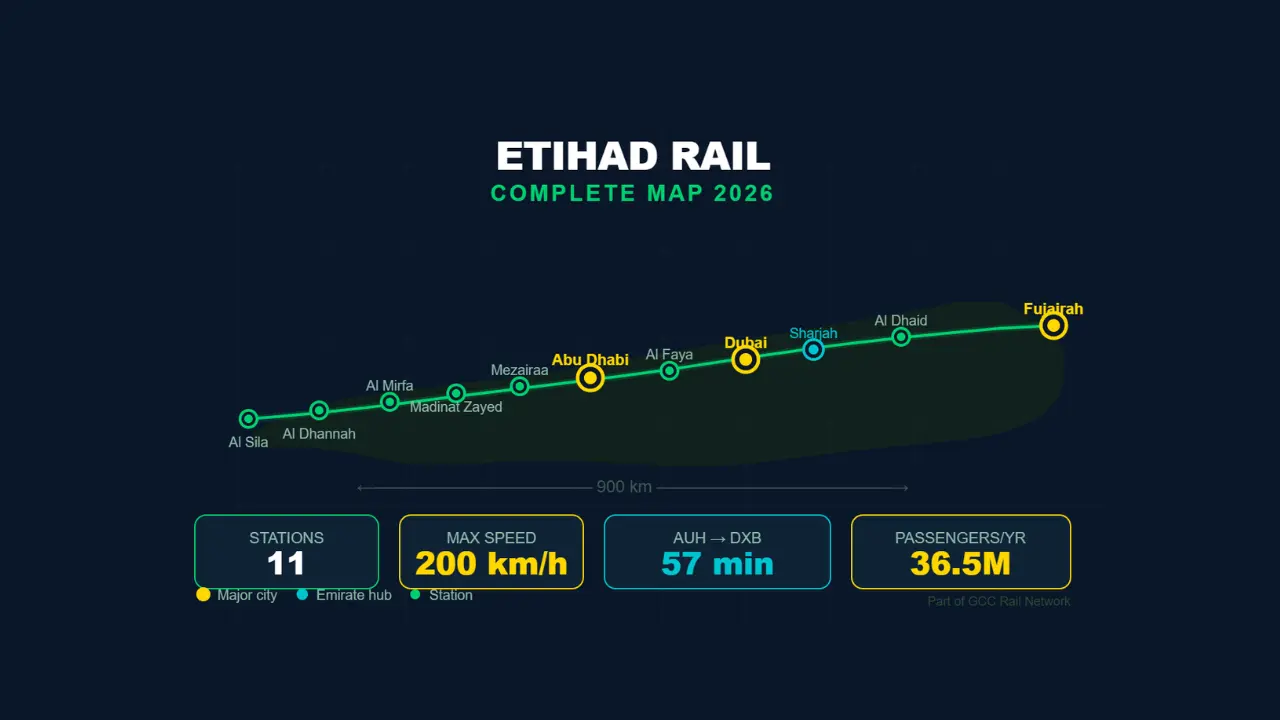
The route stretches 900 kilometres from Al Sila in Abu Dhabi’s western Al Dhafra region to Fujairah on the east coast — the full width of the country. This isn’t a city-to-city shuttle; it’s a genuinely national corridor covering all seven emirates.
Eleven cities and regions are confirmed on the network. Stations were announced in two batches: the first four (Abu Dhabi, Dubai, Sharjah, Fujairah) came in early 2025, followed by the remaining seven later that year. All 11 will become operational in phases throughout 2026, not simultaneously.
The complete station list:
- Al Sila — westernmost point, UAE-Saudi border, future GCC Railway gateway
- Al Dhannah — western Abu Dhabi energy and industrial zone
- Al Mirfa — coastal Al Dhafra region
- Madinat Zayed — central Abu Dhabi emirate
- Mezairaa — agricultural interior of Abu Dhabi
- Abu Dhabi — Mohammed Bin Zayed City, near Dalma Mall
- Al Faya — between Abu Dhabi and Al Ain, connected to AD Ports’ dry port
- Dubai — near Jumeirah Golf Estates, with Dubai Metro interchange
- Sharjah — University City, roughly 10 minutes from Sharjah International Airport
- Al Dhaid — northeast Sharjah emirate
- Fujairah (Al Hilal) — eastern terminus, serving Fujairah city and nearby Qidfa
The first stations to open are expected to be Abu Dhabi, Dubai, and Fujairah, as these carry the highest passenger demand.
Where the Stations Actually Are
Most coverage stops at listing city names. But for daily commuters and tourists, the specific location within a city matters just as much.
Abu Dhabi Station sits in Mohammed Bin Zayed City, close to Dalma Mall, in the southern urban belt between Mussafah Industrial Area and the city proper. Etihad Rail released interior footage of the completed station in early 2026, showing ticket barriers, digital displays, and platform access.
Dubai Station near Jumeirah Golf Estates connects directly to the Dubai Metro’s Route 2020 extension. It sits approximately 30 minutes from Al Maktoum International Airport, the airport being expanded into what is planned to become one of the world’s largest aviation hubs.
Sharjah Station in University City is positioned to serve the thousands of students and staff at the emirate’s major academic institutions. Its proximity to Sharjah International Airport adds a dual function: this station effectively serves both intercity commuters and air travellers.
Fujairah Station at Al Hilal was the first to be fully completed. It already has food outlets, a car park, waiting areas, ticket vending machines, car rental desks, and a taxi rank — essentially a working station waiting for the trains to arrive.
Al Sila carries the most strategic weight despite being the least populated stop. It’s positioned at the Saudi border as the future connection point for the GCC Railway, a multi-country rail ambition across the Gulf.
Journey Times: The Numbers That Change Things
These are officially published estimated durations — not yet a confirmed timetable, which will be released closer to or at launch.
| Route | Expected Journey Time |
|---|---|
| Abu Dhabi → Dubai | 57 minutes |
| Abu Dhabi → Al Ruwais | 70 minutes |
| Abu Dhabi → Fujairah | 105 minutes |
| Sharjah → Dubai | ~15 minutes |
The Abu Dhabi–Dubai figure dominates headlines, and rightly so — the same trip by car during peak hours can exceed 90 minutes. But the Sharjah–Dubai number may prove even more transformative for daily life. Sharjah residents face some of the country’s worst road congestion; a 15-minute train ride would fundamentally reshape the cost and stress of the daily cross-emirate commute.
Trains will operate at speeds of up to 200 km/h, cutting travel times by roughly 30 to 40 percent compared to road travel.
A Separate High-Speed Line
Alongside the 900 km national network, Etihad Rail has separately announced a dedicated high-speed corridor between Abu Dhabi and Dubai, targeting speeds of up to 350 km/h — cutting that journey to around 30 minutes. This is not the same service as the national passenger network. It will have its own dedicated stations and is positioned as a premium, ultra-fast option. No confirmed launch date for this line has been announced as of mid-2026.
Inside the Trains
Two train models will operate on the network:
- CRC coaches — manufactured in China, seating around 365 passengers
- CAF coaches — designed by Spain’s CAF (Construcciones y Auxiliar de Ferrocarriles), seating around 369 passengers
Both share the same three-class layout. Each train carries up to 400 passengers in total.
Economy Class uses face-to-face seating in dark grey — practical for short trips between major cities.
Family Class has opposing seats around shared tables, built for group travel. In a country where travelling as a family unit is the norm, this is a thoughtful design choice rather than an afterthought.
First Class offers wider, adjustable seating focused on comfort and productivity.
All cabins come with Wi-Fi, individual charging outlets, foldable tables, overhead luggage storage, and onboard food and beverage service. Train crew and station staff wear cream and red uniforms; drivers wear grey and black.
How Ticketing Works
Passengers enter stations through smart electronic gates by scanning their tickets. Etihad Rail recommends booking online in advance, though ticket vending machines will be available at every station. The machines allow passengers to select travel class, choose their route, and make special requests. Confirmed payment methods include cash, debit and credit cards, and Apple Pay.
Ticket prices haven’t been officially published. The expectation, based on statements from officials, is that fares will be competitively priced relative to road travel costs — factoring in fuel, Salik tolls, and parking, rail becomes financially attractive even before time savings are considered.
Last-Mile Connectivity: Still Being Worked Out
The stations are built and the trains are ready. What remains less defined, publicly, is how passengers move from each station to their final destination.
Etihad Rail has confirmed it is working on “last-mile” connections — integrating each station with buses, metro links, taxis, and ride-hailing services. A deal with a ride-hailing company was signed at the Global Rail conference in Abu Dhabi in late 2025. For Dubai and Sharjah, existing transport networks provide a reasonable starting point. For stations in the Al Dhafra region, where private car ownership is near-universal, feeder bus routes will need to be developed in parallel with the rail launch.
The quality of these connections will determine whether the network reaches its ridership targets. A fast train that drops passengers in an area with no onward transport solves half the problem.
The Freight Foundation
Passenger services aren’t launching on untested infrastructure. Etihad Rail has been running freight trains since 2016, when Phase 1 began transporting sulphur between Shah, Habshan, and Ruwais across 264 kilometres. By 2023, the full 900km network was operational for freight, connecting key ports and industrial zones including Khalifa Port in Abu Dhabi, Jebel Ali Port in Dubai, and the Port of Fujairah.
The passenger launch is built on this foundation. The tracks, signalling, and operational systems already exist — what 2026 adds is stations, onboard passenger experience, and commercial ticketing.
Regional Connections: Oman and the GCC
Two cross-border rail projects are in active development:
Hafeet Rail is a 303km line connecting Sohar in Oman to Al Wathba in Abu Dhabi. Etihad Rail, Oman Rail, and Mubadala Investment Company signed a construction agreement in 2024. Once built, it will integrate directly with the UAE national network and open the first direct passenger and freight rail link between the two countries.
GCC Railway is the longer-term regional ambition — a network spanning Gulf Cooperation Council countries with a connection to Saudi Arabia via the Al Sila station. Progress on the GCC Railway has historically been slow, but the UAE’s Al Sila positioning reflects a genuine architectural commitment to this future link.
FAQs (Etihad Rail Map 2026)
When does Etihad Rail passenger service officially open?
In 2026, with stations becoming operational in phases. Abu Dhabi, Dubai, and Fujairah are expected to open first. A specific date has not been publicly confirmed as of June 2026.
Will all 11 stations open at the same time?
No. Etihad Rail has stated clearly that stations will be commissioned in phases. The western Abu Dhabi stations are expected in later phases.
Is Etihad Rail the same as Etihad Airways?
No. They share the name as a reference to UAE unity but are entirely separate organisations. Etihad Rail is a federal infrastructure project managed under Federal Law No. 2; Etihad Airways is the national airline. A “Rail & Fly” intermodal partnership between the two has been discussed but not formally launched.
Where is the Dubai station located?
Near Jumeirah Golf Estates, with a direct Dubai Metro interchange at the Jumeirah Golf Estates station. Roughly 30 minutes from Al Maktoum International Airport.
Are tickets on sale yet?
Not as of mid-2026. Ticketing is expected to open online ahead of the commercial launch, with vending machines at all stations.
What happens after 2026?
The network is projected to carry 36.5 million passengers annually by 2030, with Oman connectivity through Hafeet Rail and eventual GCC Railway integration on the long-term roadmap. The national railway programme is also projected to create more than 9,000 jobs across engineering, operations, maintenance, and transport technology by 2030.